
Danbury Parole and Probation Compared
Parole and probation both place rules on a person in the community, but they begin in different ways. The Connecticut Board of Pardons and Paroles, often called BOPP, decides whether an eligible state prisoner should be released on parole. CT DOC Parole and Community Services then handles community supervision for people released under the Board or the Commissioner of Correction. Probation is part of a court sentence. A Danbury probation case remains tied to the Connecticut Judicial Branch and its Court Support Services Division, even if the person first spent time at Bridgeport Correctional Center.
Special parole is another distinct status. It is a period of supervision ordered as part of a sentence and begins after confinement. The CT DOC public inmate record may show a special parole date, but that field is not the same as an estimated or maximum release date. Federal supervised release is separate as well. A person leaving FCI Danbury follows federal court and U.S. Probation channels, not BOPP or Danbury Adult Probation.
| Status | How it begins | Danbury verification source |
|---|---|---|
| Parole | BOPP grants release after finding an eligible person suitable | BOPP hearing information, CT DOC fields, and Parole and Community Services |
| Probation | A court imposes supervision as part of a sentence | Danbury court docket and Adult Probation |
| Special parole | A sentence includes a post-confinement supervision term | CT DOC special parole field, court record, and supervision office |
| Federal supervised release | A federal sentence includes supervision after BOP custody | Federal court and U.S. Probation records |
- Parole
- Conditional release from a state prison sentence before the sentence fully ends.
- Probation
- Court-ordered community supervision that may follow custody or serve as an alternative to it.
- Discharge
- The formal end of a custody sentence or supervision term.
- Absconder
- A supervised person reported as no longer complying with required contact or location rules.
Verify Danbury Post-Release Supervision
Begin with the source that created the status. A person released after a Danbury police arrest may be on court probation without ever receiving parole. Someone serving a CT DOC sentence may have parole, special parole, transitional supervision, or no supervision after discharge. A no-result in the current CT DOC search does not resolve the question because the public search is strongest for people now under DOC custody and is populated through a nightly feed.
- Search the official CT DOC inmate search page. Use an inmate number or the first few letters of the last name, then confirm date of birth and status.
- Review current location, maximum release date, estimated release date, special parole date, and detainer information. Do not read one field as proof of every status.
- Check the BOPP hearing links and calendar if parole was considered. A decision may identify a denial, a later hearing, or a voted-to-parole date.
- Use the Connecticut Judicial Branch pending and conviction searches for a Danbury probation sentence or violation case. Select Danbury Geographical Area 3 and Judicial District when the form requests a court location.
- Register with CT SAVIN under the appropriate court or correctional record when future changes matter. Registration under both records may be needed.
- Call the office responsible for the status when public records do not settle identity, assignment, or whether supervision has ended.
The broader Danbury released-inmate search explains how to reconcile police, court, CT DOC, federal, and immigration records when the custody path is uncertain.
Note: A CT DOC no-result can follow discharge, a transfer, a search mismatch, or a statutory restriction, so check the court record too.
Danbury Supervision Offices and Records
Danbury has a local Adult Probation contact at the courthouse, but no separate Danbury parole district appears on the CT DOC Parole and Community Services page. The state division lists district offices in Bridgeport, Hartford, New Haven, Norwich, and Waterbury, along with specialized units. A Danbury-area parole assignment may therefore be handled by a regional office or unit rather than a city office. Ask for general public information and the correct office. Do not assume that the nearest office owns the case.
Danbury Adult Probation
Superior Court, Danbury Judicial District / GA 3
146 White Street
Danbury, CT 06810
Phone: 203-797-4414
Court hours: 9 a.m. to 5 p.m.; doors open at 8:30 a.m.
CT DOC Parole and Community Services
24 Wolcott Hill Road
Wethersfield, CT 06109
Phone: (860) 692-6901
Board of Pardons and Paroles
55 West Main Street, Suite 520
Waterbury, CT 06702
Phone: 203-805-6605
Hours: Monday through Friday, 8 a.m. to 4:30 p.m.
Email: ct.bpp@ct.gov
The Danbury courthouse directory is the official source for Adult Probation and clerk contacts. The CT DOC supervision page identifies the statewide division and specialized units. These contacts answer different questions, so the court office should not be used as a substitute for parole records.
Danbury Parole Hearings and Decisions
Parole hearings for people with Danbury cases are statewide proceedings, not hearings at the Danbury courthouse. BOPP says hearings may occur Monday through Friday and generally begin at 9 a.m. unless a different time is posted. The person appears by video from the correctional institution. A three-member panel and parole officer take part, and the panel deliberates in open session before giving a decision. Hearings are placed on the schedule only when the Board has the information it needs for the case.
A grant does not set a guaranteed exit time. BOPP calls the date a “voted to parole” date and describes it as an on-or-after date. Release can occur later while a field officer works with the inmate and sponsor on transportation and placement. New charges, discipline, a failed program, a return from a halfway house, or other new facts can lead the Board to add conditions, offset the date, modify the grant, or rescind it. A denial may include reasons and another hearing date. Reconsideration is rare and reserved for major new facts such as a sentence change or serious health decline.
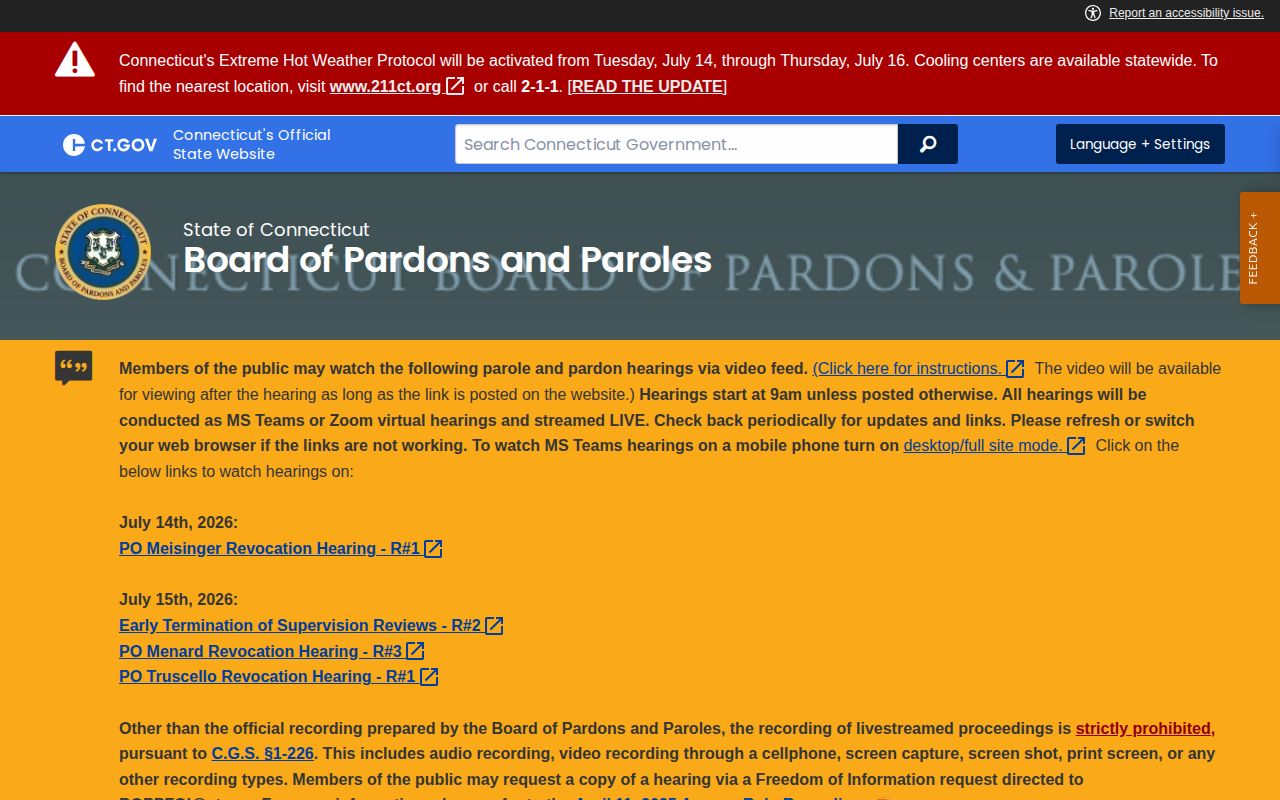
The BOPP public hearing information explains the format and calendar. Livestream recording and screenshots are prohibited under CGS § 1-226, except for the Board’s official recording. Copies may be requested through BOPP FOI at BOPPFOI@ct.gov.
The official parole eligibility page shows the eligibility framework described below.
Danbury Parole Eligibility Rules
Eligibility asks whether the Board has legal authority to parole someone at a given point. Suitability asks whether release should be granted. Those are separate decisions. Under BOPP’s explanation of CGS § 54-125a, a person convicted of an offense involving the use, attempted use, or threatened use of physical force generally must serve at least 85 percent of the total effective sentence, less jail credit, before parole. For covered offenses committed on or after July 1, 2013, Risk Reduction Earned Credit does not move that 85-percent parole eligibility date.
Some offenses are generally parole-ineligible, including murder, capital felony murder, felony murder, arson murder, and aggravated sexual assault in the first degree. BOPP notes a youth-offender route under CGS § 54-125a(f) for some people whose offense occurred before age 18. Eligibility still does not ensure a grant. The Board reviews suitability and may deny parole even after the legal threshold is reached.
Note: “Eligible” means the Board may act; it does not mean the person has been approved or released.
Danbury Absconder and Warrant Checks
No official Danbury-specific absconder list was found. CT DOC Parole and Community Services does identify a Fugitive Investigations Unit. It lists (203) 346-7830 and Stephen.Faiella@ct.gov for anonymous tips. That unit is an official path for parole supervision issues, but its contact details are not a public roster of everyone with a warrant. A probation violation usually appears through the court process, and a parole revocation or rescission follows DOC and BOPP procedures.
CT SAVIN may issue notice of escape, return to custody, or absconding from a community-release placement when the feeding record covers that event. It should be read as a status notification, not a complete warrant search. If a person may be in immediate danger, contact emergency services. For a record question, use the agency responsible for the supervision type and confirm any name match with official identifiers.
Danbury Reentry After Parole
Connecticut’s reentry work begins before release. CT DOC Offender Reentry Services says each facility has a full-time Reentry Counselor and that intensive work begins 18 months before release. Staff can help with referrals, vital programs, bus passes, and warm handoffs to Reentry Welcome Centers. A warm handoff means staff connect the person directly to the next service instead of only giving a phone number.
Danbury also has a local point of reference. The Danbury Library reentry resources page gathers information for people returning from incarceration. That local resource does not verify parole terms. It can help with practical needs while the assigned parole or probation officer remains the source for conditions, reporting, travel, and discharge questions.
Danbury Release ID and Property
Identification can remain in the corrections system after release. CT DOC says an ID brought into custody is kept apart from other property and remains at the facility until discharge. If it is not claimed, the facility holds it for 30 days. The ID then goes to CT DOC Central Office, where it may be stored for up to two years.
To ask whether an ID reached Central Office, use 860-692-6836, 860-692-7869, or DOC.ORSU@ct.gov. Questions about property retained by Danbury Police use the Records & Property Division property line at 203-796-1647. These are property-recovery channels, not supervision verification channels, but getting the correct ID can be vital when reporting to an assigned office and using reentry services.
Note: Contact the facility first during its 30-day holding period; Central Office becomes the next source only after transfer.
When Danbury Supervision Ends
Supervision ends through a formal agency or court action, not simply because a person no longer appears in custody search results. A parolee reaches discharge under the terms of the state sentence and Board or DOC authority. Probation ends under the court sentence, unless a violation or later court order changes the term. Special parole has its own sentence-based period. The court docket, DOC record, BOPP material, and assigned office should agree before the status is treated as complete.
CT SAVIN also has an end point. CT DOC says notifications generally stop once the person discharges and completes the Connecticut sentence. If post-incarceration probation remains and a violation returns the person to the system, a new notice may occur. Re-registration may be needed if the person later re-enters the justice system. That limit is why an old notification subscription is not proof that supervision remains active or has ended.